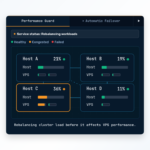
Every Cloud VPS now runs with Performance Guard, our cluster load balancing system. It watches host load across the whole cluster and moves work off a busy host before the neighbors there slow your VPS down. Every Cloud VPS plan includes it. You do not have to turn it on. The noisy neighbor problem A…
We are now offering WordPress Toolkit Deluxe with our cPanel/WHM licenses at no extra cost. This toolkit provides an easy to use interface for configuring, securing, updating, and managing WordPress sites. WP Toolkit Deluxe automates, accelerates, and streamlines WordPress management, helping cPanel & WHM users to efficiently maintain, secure, and configure multiple sites in one…
As your hosted services grow there comes a time when growth requires you to shift away from a monolithic approach with interwoven services in a single server. These approaches do not scale well, and their performance will suffer. And, as we all know, performance loss…
Ransomware has once again dominated headlines in 2021. Attackers have been given no shortage of targets with so many companies shifting to using VPS for remote offices. Studies have shown that a staggering 92% of organizations who paid a ransom did not get their data back. Furthermore, once the ransom is…
Application hosting, or Platform as a Service, is the next generation of virtual hosting. It’s gaining popularity as the go to platform for hosting web applications, and databases. This includes CMS like WordPress and Drupal, as well as applications running Java, PHP, Node.JS, Python, Go, and Ruby. App hosting enables you to host your app…
Application hosting is the next generation of virtual hosting and cloud computing. There are some key differences when compared to VPS Hosting. But first, what is Application Hosting? App Hosting/Application hosting is a type of virtual hosting. It can be considered a Platform-as-a-Service (PaaS) Model, or a Software-as-a-Service (SaaS) Model. Application hosting allows you to…
Togglebox is partnering with Jelastic to provide Docker Swarm Auto-Clustering and Scaling with PaaS Power Armor. Docker Engine nodes that are run in a swarm mode constitute a fault-tolerant platform for application hosting with built-in cluster management features. It helps to keep your dockerized services constantly running and available across different servers and data centers.…
Togglebox is partnering with Jelastic to provide Spring Boot Hosting and Spring Boot server for standalone and clustered applications or microservices. With the Spring Boot stack template, you can run various Java-based applications inside the cloud via easy-to-use graphic interface or automation scripts. These Java project types can be hosted: JAR – for standalone Java apps or…
Togglebox is partnering with Jelastic to become a truly multilingual cloud platform. We will be providing Java, PHP, Python, Ruby, Node.js, .NET, and Golang. The distinctive features of the Go hosting and will be introduced in this article. Go Environment Hosting 1. Create the appropriate environment using Togglebox UI’s Topology Wizard 2. Switch to the…
Get new guides by email
We send a note when a new guide or release lands. No marketing drip.
[contact-form-7 id="17879" title="Blog Update List"]
Ready to move from research to deployment?
Use the blog for planning, then switch to a product page for pricing and launch steps.